Pray
Carry your people to God, and keep what He does.
A living prayer list for the people and needs actually in your life — with every answered prayer kept, so your own history becomes a testimony.
Pray
A living prayer list for the people and needs actually in your life — with every answered prayer kept, so your own history becomes a testimony.
Imagery from Psalm Path for iPhone
A prayer’s whole life
Three states, and no more. There is deliberately no “lapsed” or “neglected” — Psalm Path has no vocabulary for a prayer you haven’t got round to, because it has no opinion about that.
Being prayed. A prayer stays here as long as it needs to — a week, a season, twenty years. It is never demoted for waiting.
Marked by you, kept forever. Your answered prayers become an Ebenezer — a growing record of God’s faithfulness you can return to on hard days.
Some prayers change rather than resolve. Archiving is not failure — it’s where those prayers rest, still part of your story.
No filing chores
Categories you’d have to invent and maintain are a chore standing between you and praying. Psalm Path’s twelve shelves cover what people actually pray for — tap one and pray, or skip it entirely.
Fifteen ways in
So every way into prayer opens with the words to start with — “God, I’m afraid that…”, “I’m willing to forgive…” — and gets out of the way once you’re going.
Morning, midday, evening, night — each with its own register, so seven in the morning doesn’t pray like midnight.
Grateful, anxious, grieving, needing to forgive, needing direction. The mode meets the day you’re actually having, not the one you planned.
An exam, work, a relationship, healing, someone you love. And when words run out entirely — pray a psalm back to God, a stanza at a time.
Praying Scripture
Eight passages the church has always prayed — a psalm of trust, the Lord’s Prayer, the shepherd’s psalm — opened a few verses at a time. Read the words, sit in the pause, then pray them back in your own voice.
The Scripture on screen is always Scripture itself, drawn from the Bible on your phone in the translation you chose — never a paraphrase, never generated.
A time of prayer
For the person who wants to pray longer and doesn’t know how, a guided time of prayer moves through the shape the church has taught for four centuries — settle, adore, confess, give thanks, ask — with your own prayer list woven in.
And while you pray, the distraction shield can hold the loudest apps back, so the device in your hand stops working against the quiet it’s holding.
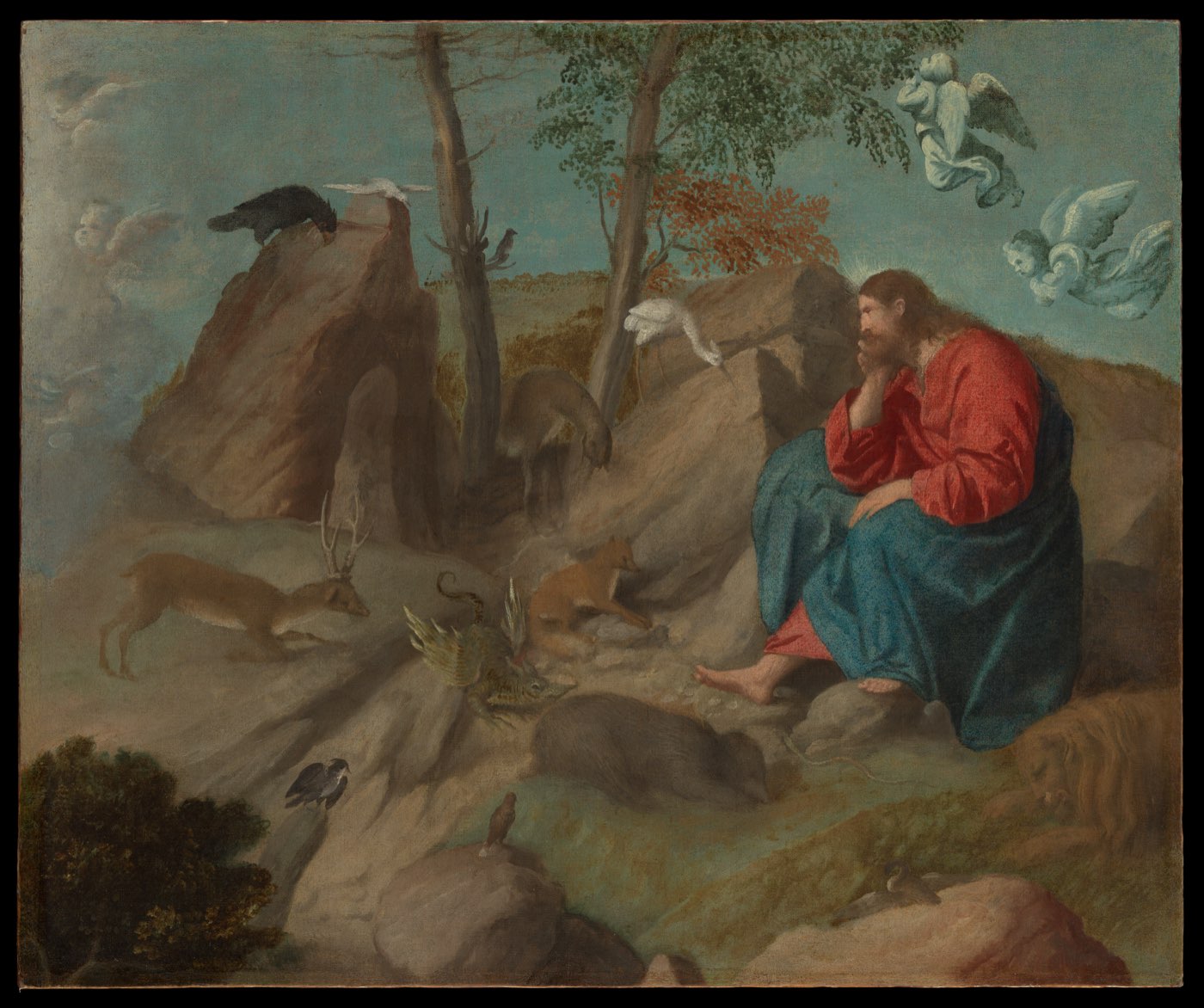
Moretto da Brescia, Christ in the Wilderness, ca. 1515–20
Fasting
Fast the way the church always has — a full fast, a Daniel fast, one meal given to prayer, dawn to dark, or a fast from screens. Three days, as Esther did; twenty-one, as Daniel did; or open-ended, until it’s settled.
When it gets hard, one button turns hunger into prayer. There is no “broken” state and there never will be — a fast is a practice, not a performance, and it is never graded.
Almost nobody fasts once. Keep a rhythm — Wednesdays, twenty-one days, all of Lent — and Psalm Path remembers it for you: a gentle reminder the evening before, quiet hours respected, and afterwards a record read with grace, never a grid of gaps.
Sealed by design
Prayer text is wrapped in a type that refuses to print itself, so it can’t slip into a log or a diagnostic by accident — and there is no server of ours for it to go to. Reading a prayer’s contents is a deliberate act even for the software itself.
“Cast all your worries on him, because he cares for you.”1 Peter 5:7 · World English Bible